
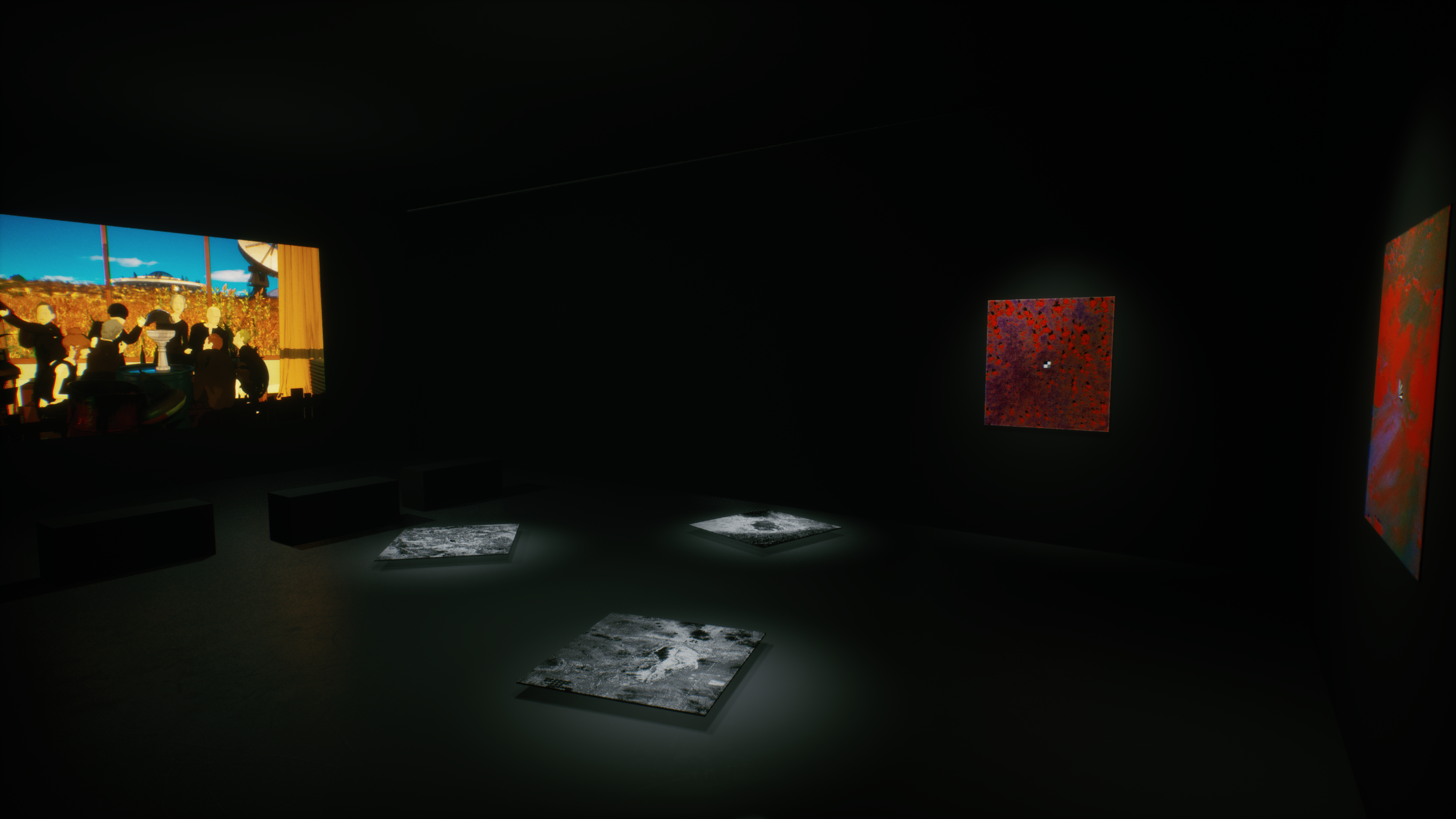
End of Signal
What does it mean, under contemporary earth-observation regimes, to see everything and still misread? What space can uncertainty retain when observation is coupled to adjudication, when vision is engineered not to dwell but to authorize? In End of Signal, Cezar Mocan takes this tension as a point of departure.
A toxic lake disappears from satellite view during a solar eclipse and reappears at dawn; an insurance claim is filed for its “temporary non-existence”; witnesses diverge, and the datasets do not quite align. The exhibition treats this small fracture as both narrative device and lens onto a broader condition: it shows how poorly both institutions and machines cope with not knowing. Rather than critiquing the surveillance apparatus from a safe distance, Mocan inhabits its interior. The narrative voice is that of a distributed satellite — seventy-two “eyes” in low Earth orbit — trying to reconstruct what happened to the lake and repeatedly falling short. Its spiraling attempts to explain the anomaly, its accumulation of incompatible testimonies, appear less like an otherness and more like a reflection of our own difficulty in living with the unknowable.
End of Signal argues that contemporary infrastructures of vision do not coexist with uncertainty — they manufacture it, spinning reality into versions, each persuasive enough to intensify unknowability, each partial enough to cancel the next. What shifts is not truth — which has long been partial, negotiated, constructed — but the texture of not knowing: less a gap produced by missing information than a surplus of plausible versions, enough to stall judgment while still demanding it. A system that cannot stop looking, and cannot reconcile what its looking is doing.
(excerpt from text by Sofia Enriquez G.)
Location: Bay 1, The Digital Hub
Exhibition Dates + Times: 6-22nd of November, Wednesday to Sundays, 12-6pm
Artist Name/s (Pronoun/s): Cezar Mocan